
How Your Phone Connects to Satellites (And Why It's Getting Smarter)
The Hook
Have you ever wondered how your phone keeps working when there's no tower in sight?
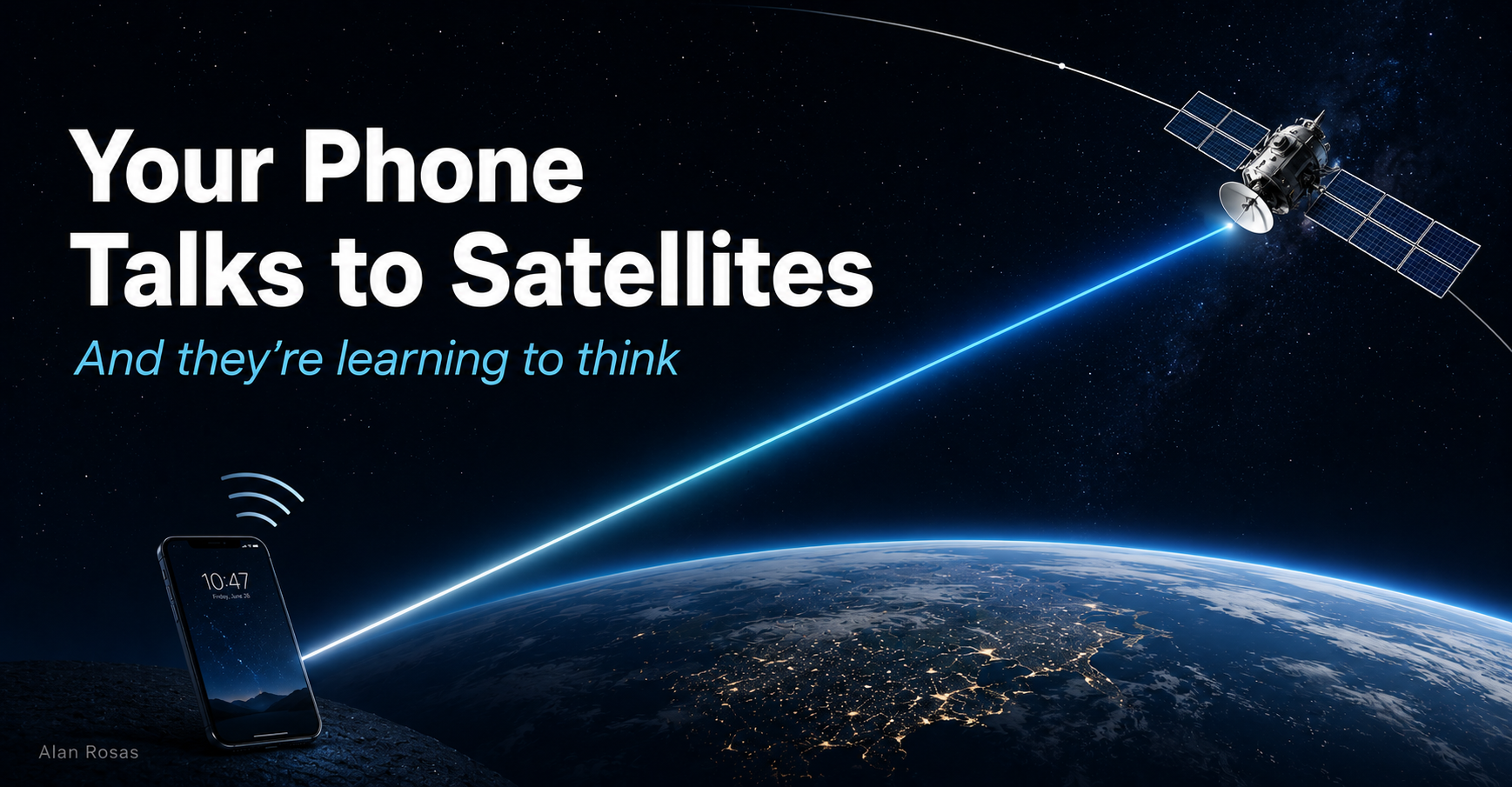
You're hiking. The trail dips behind a ridge. The signal bars vanish. Then—out of nowhere—a text goes through anyway. No tower. No WiFi. Just your ordinary phone, talking to something 550 kilometers above your head.
That "something" is a satellite. And it's about to get a lot smarter.
Today: Satellites That Can't Think
Here's the part most people don't know: your phone can already reach satellites. Not a special device. Not a bulky antenna. The phone in your pocket.
Companies like Starlink, AST SpaceMobile, and the carriers partnering with them have made it work. Send a text from the middle of nowhere. Get an emergency alert where no cell tower exists. It's real, and it's happening now.
But there's a catch. Today's satellites are, to put it bluntly, kind of dumb.
They follow fixed plans. A ground engineer decides, hours in advance, which satellite covers which patch of Earth, on which frequency, at which moment. The satellite just executes the script. It doesn't look around. It doesn't react. It does exactly what it was told, even when reality has changed.
The Problem: Reality Doesn't Wait
The trouble is that everything up there moves.
A satellite over your city right now will be over the ocean in fifteen minutes. The next one is already rising over the horizon to take its place. Your phone has to be handed off from one to the next, smoothly, without you noticing—like a relay runner passing a baton at full sprint.
Now multiply that. Thousands of satellites. Millions of phones. Weather that scatters signals. A sudden crowd at a stadium demanding bandwidth all at once. A frequency that worked perfectly a minute ago, now jammed with interference.
When a satellite can only follow a pre-written script, it can't respond to any of this. The plan was written for the world as it was expected to be, not the world as it actually is. So calls drop. Speeds crawl. Connections stutter.
Fixed routes in a world that never stops moving. That's the bottleneck.
Smart Satellites: Deciding in the Moment
So what's the fix? Let the satellites decide for themselves.
Instead of blindly running a script, a smart satellite watches what's actually happening around it—and adjusts in real time:
"My signal to this region just weakened. Let me hand these users to my neighbor."
"Demand is spiking over the city below. Shift more capacity there, now."
"This frequency is getting noisy. Switch to a cleaner one before quality drops."
No waiting for an engineer on the ground. No round-trip delay while a request travels up and a command travels back. The satellite sees, decides, and acts—in the time it takes you to blink.
Think of it like the difference between a paper bus schedule and a ride-share app. The paper schedule is fixed: the bus comes at 3:15 whether or not anyone's waiting, whether or not the road is flooded. The app reroutes the car around the flood, sends more drivers where the crowd is, and adapts every second. Smart satellites turn the network from a printed timetable into a living, reacting system.
What This Means For You
Today: You can text from off-grid. Slowly. With gaps. Good enough for an emergency, not much more.
Soon (the next few years): That same off-grid connection gets faster and steadier. The network quietly reshuffles itself to keep your call clear, your video from freezing, your message from stalling—and you never see any of it happen.
Why it matters: Roughly a third of humanity still has no reliable internet. Not because the technology doesn't exist, but because laying cables and building towers in remote regions costs a fortune. Smart satellites change that equation. A village with no tower for a hundred miles could get a connection as dependable as a downtown café—and cheaper to provide, because the network runs itself instead of needing constant human babysitting.
The One Big Challenge: Fairness
Here's the question that keeps me up at night.
When a satellite decides on its own where to send capacity, who gets it first?
The city paying premium rates? Or the rural clinic that needs to send a patient's scan to a distant hospital? When the network optimizes itself, it optimizes for something—and whoever defines that "something" quietly decides who matters.
A smart network is only as fair as the goals we give it. Make it chase pure profit, and it will starve the places that need connection most. Build fairness into its objectives from the start, and it can do the opposite—reaching the people the old system left behind.
That's not a technical detail. It's a choice. And it's exactly the kind of question my doctoral research is trying to answer: not just can networks govern themselves, but how do we make sure they govern themselves well.
The Bottom Line
Your phone already talks to satellites. That part is settled.
The next leap isn't about adding more satellites—it's about making the ones up there think. Watch. React. Decide. And do it in a way that's fast, reliable, and fair.
The dumb satellites got us connected. The smart ones will decide what that connection is worth—and to whom.
Want Deeper Context?
Next post (in two weeks): we leave orbit and zoom out to the bigger idea—networks that make decisions without any humans in the loop at all. What does it actually mean for a system to "govern itself," and should we trust it?
For now, just remember this the next time a message sneaks through from the middle of nowhere: something up there is starting to think.
Alan Rosas Palacios
Researching the future of 6G networks. CIO at Co.De Aerospace. Full-stack engineer.
Let's explore how networks become intelligent—together.