
Why Satellites Need Intelligence (And How It Affects Your WiFi)
The Hook
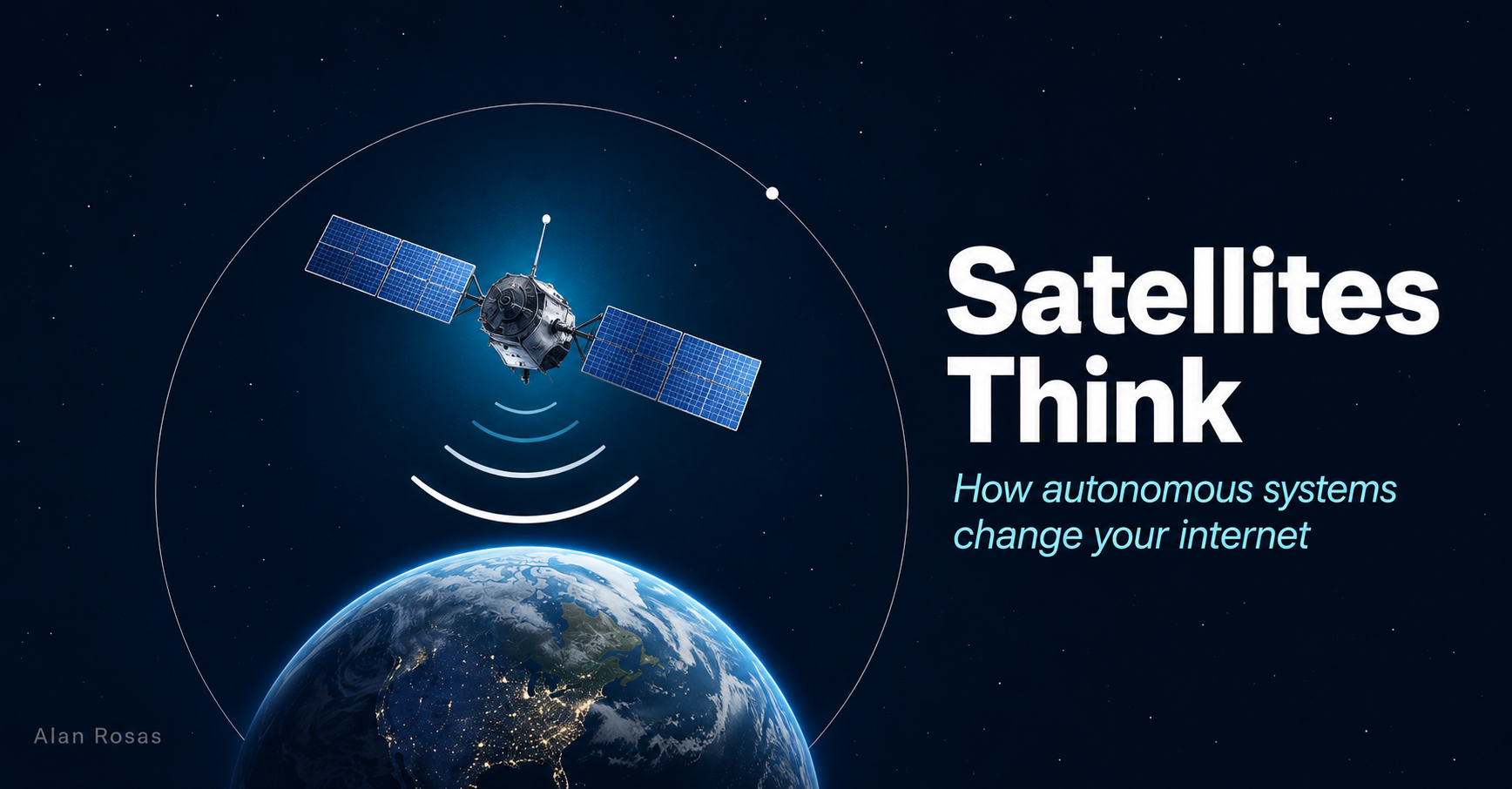
What if I told you the satellites overhead are learning to think?
Not in a sci-fi way. But literally learning, right now, how to make your internet faster.
The Current Reality
Right now, about 5,000 satellites orbit Earth. Starlink. OneWeb. Amazon’s Kuiper. More launching every month.
Here’s the problem: satellites move fast . A satellite over Mexico today will be over Europe in 90 minutes. Coverage zones overlap. Disconnect. Reconnect. Your connection bounces between satellites constantly.
When a satellite moves, someone has to manually tell the network to adjust. That takes time. Minutes, sometimes hours. Not ideal when you’re trying to video call.
Why Manual Control Is Dead
Imagine trying to direct traffic in a city where the roads constantly rearrange themselves. That’s what 6G satellite networks are like.
In 5G, networks are mostly static. Towers don’t move. You plan coverage, set it up, done.
In 6G? Thousands of satellites. Drones. High-altitude platforms. Everything moving. Everything changing.
You can’t have humans sitting in control rooms manually adjusting every decision. It’s too fast, too complex, too expensive.
You need the network to adjust itself.
Enter: Autonomous Intelligence
What if each satellite could observe what’s happening around it and make smart decisions in real-time?
“My signal is weak here. Route traffic to my neighbor satellite.”
“This user’s connection is getting slower. Switch them to the stronger satellite.”
“A storm is interfering with my signal. Adapt my frequency.”
No central authority. No waiting for human approval. Each satellite makes decisions locally, and somehow the whole system coordinates itself.
That’s autonomy. That’s intelligence.
How It Works (Simply)
Think of Waze, the navigation app.
Millions of drivers send data about traffic. Waze analyzes it in real-time. You get rerouted to avoid congestion. No central command center ordering you where to drive. You make the decision based on the data you see. Order emerges from chaos.
Autonomous satellite networks work the same way.
Each satellite observes its local situation (signal strength, user demand, interference). It makes decisions (allocate spectrum, reroute traffic, adjust power). The whole network coordinates without a central controller.
Result? Faster, smarter networks that adapt instantly.
What This Means For You
Today: Your phone connects to a satellite. That connection is static. Changes take minutes.
Tomorrow (next 3–5 years): Your phone still connects to satellites. But now the network reroutes your traffic automatically, millisecond by millisecond, without you noticing. Better speeds. Zero latency. No dropped calls.
Why you should care: In 2030, global internet will depend on these smart satellite networks. Better coverage in remote areas. Lower costs for internet providers (which means cheaper for you). More reliable connections anywhere on Earth.
The Challenges (Real Talk)
Of course, it’s not all sunshine. Big questions remain:
Trust: Can we trust machines to make critical decisions? What if an AI makes a “wrong” choice?
Security: What stops a hacker from exploiting an autonomous network?
Regulation: International agencies (ITU-R) are still figuring out the rules.
Fairness: How do we ensure decisions benefit everyone, not just powerful operators?
These are the questions I’m researching in my doctoral work. Not easy. But necessary.
The Bottom Line
6G networks won’t just be faster. They’ll be smarter. More resilient. More adaptive.
And it all starts with giving networks the ability to think for themselves.
The satellites overhead aren’t science fiction anymore. They’re becoming intelligent. And whether we realize it or not, they’re already reshaping how we connect.
Want Deeper Context?
Next post (in two weeks): I’ll explain the technical framework behind autonomous networks — how these decisions actually work, with real code examples. More technical, but still clear.
For now: just know this. The future of connectivity isn’t centralized control. It’s distributed intelligence. Networks thinking for themselves.
Pretty cool, right?
Questions? Comment below. Share your thoughts on autonomous networks.
Alan Rosas-Palacios
Researching the future of 6G networks. CIO at Co.De Aerospace. Full-stack engineer.
Let’s explore how networks become intelligent — together.